
Writing down moves is compulsory in most standard tournaments, and it’s the key to reviewing your games. Chess uses a simple system called algebraic notation. Once you learn it, you can read any chess book and record any game.
In short
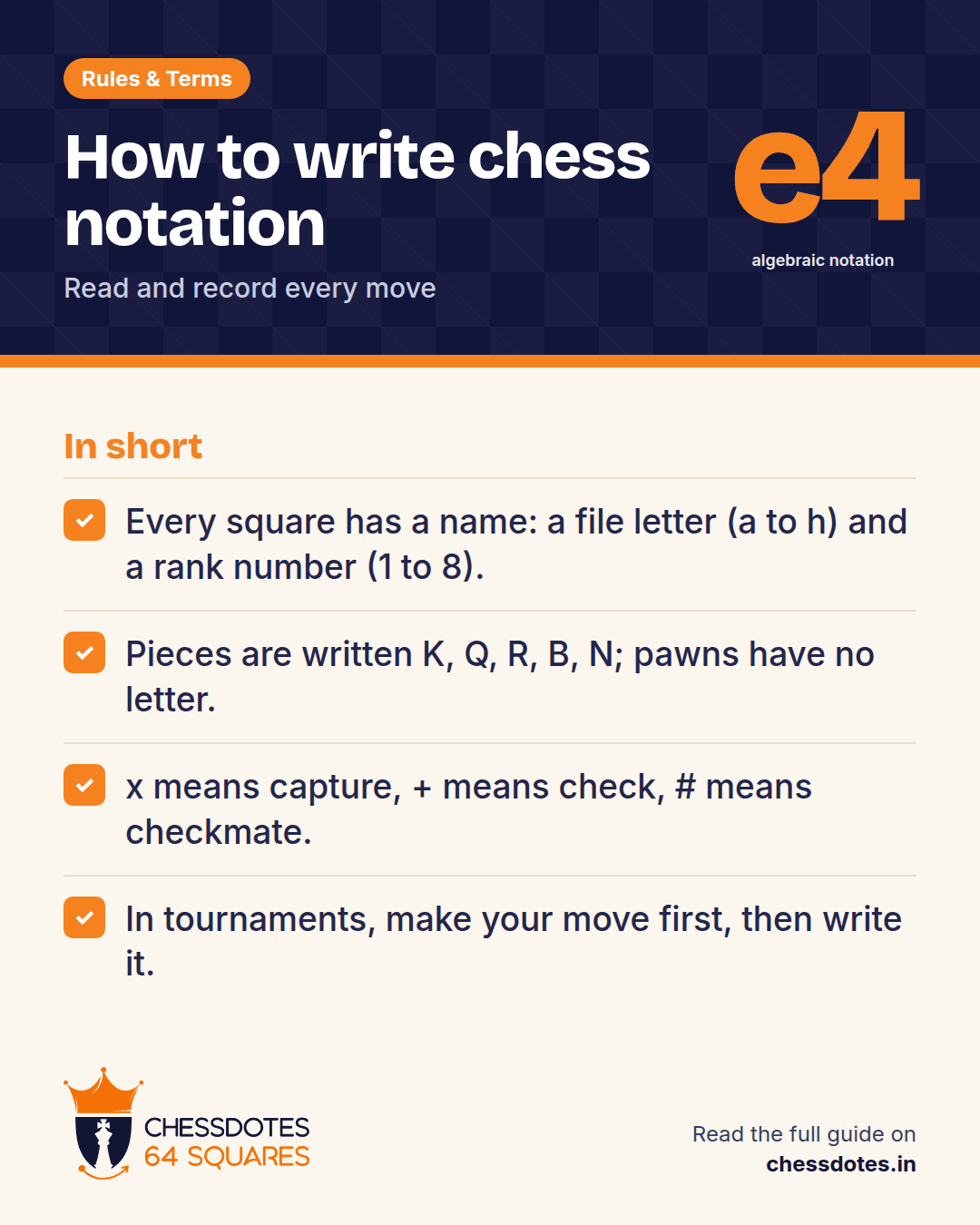
- Every square has a name: a file letter (a to h) and a rank number (1 to 8).
- Pieces are written K, Q, R, B, N; pawns have no letter.
- x means capture, + means check, # means checkmate.
- In tournaments, make your move first, then write it.
In this article
Naming the squares
Columns (called files) are labelled a to h from White’s left to right. Rows (called ranks) are numbered 1 to 8 from White’s side. So every square has a name like e4, d5 or h8. White’s king starts on e1; Black’s king on e8.
After 1.e4: White’s pawn has moved from e2 to e4.
Piece letters
Piece letters
| Piece | Letter | Example | Meaning |
|---|---|---|---|
| King | K | Ke2 | King moves to e2 |
| Queen | Q | Qh5 | Queen moves to h5 |
| Rook | R | Rd1 | Rook moves to d1 |
| Bishop | B | Bc4 | Bishop moves to c4 |
| Knight | N | Nf3 | Knight moves to f3 (N, because K is the king) |
| Pawn | (none) | e4 | Pawn moves to e4 |
Symbols
Symbols to know
| Symbol | Meaning | Example |
|---|---|---|
| x | Capture | Bxf7 (bishop captures on f7), exd5 (e-pawn captures on d5) |
| + | Check | Qh5+ |
| # | Checkmate | Qxf7# |
| O-O | Kingside castling | O-O |
| O-O-O | Queenside castling | O-O-O |
| = | Promotion | e8=Q |
| ! / ? | Good move / mistake (used in analysis, not on scoresheets) | Nd5!, Qh4? |
When two pieces can go to the same square
If both knights (or both rooks) can move to the same square, add the file or rank they came from. For example, Nbd2 means the knight on the b-file goes to d2; R1e2 means the rook on the first rank goes to e2.
Filling a tournament scoresheet
Scoresheet steps
Write your name and details
Name, round, board number, and your opponent’s name.
Make your move first
Under FIDE rules you must play the move on the board, then write it. Writing it first is not allowed (except when claiming a draw).
Record both players’ moves
Your move and your opponent’s reply, in the correct columns.
Write clearly
The arbiter may need to read it to settle a claim.
Sign at the end
Write the result (1-0, 0-1 or ½-½) and sign; both players sign both sheets.
Rule to know: In games without an increment of at least 30 seconds per move, you don’t have to write moves once you have less than five minutes left. With a 30-second increment you must always keep writing.
Practice: a short game
Try playing this on a board: 1.e4 e5 2.Nf3 Nc6 3.Bc4 Nf6 4.Ng5 d5 5.exd5 Na5. If you end with a black knight on a5, you read every move correctly.
Frequently asked questions
Q. Why is the knight N and not K?
K is taken by the king.
Q. Do I have to write moves in a rapid game?
Usually not. Check the event rules; notation is normally compulsory only in standard games.
Q. What if I make a mistake on my scoresheet?
Correct it neatly, on your own time. If you’re unsure, ask the arbiter after the game or during your turn.
Q. Can I write my move before playing it?
No. Under FIDE rules you play the move first, then write it.
Q. What is descriptive notation?
An older English system (like P-K4). Almost all modern books and tournaments use algebraic notation.
Keep reading
Practise notation with our coaches before your first tournament.
Book a trial class at ChessDotes 64 Squares. Call or WhatsApp +91-9405520323.