Once children know the basics, coaches start using bigger words: zugzwang, opposition, prophylaxis. These ideas are what separate club players from strong tournament players. Here are ten of them, explained simply.
In short
- Advanced terms describe ideas, not just moves.
- Zugzwang and opposition decide many endgames.
- Prophylaxis and zwischenzug are about thinking one step ahead.
- Pawn structure terms explain where pieces belong.
In this article
10 terms at a glance
Zugzwang
Any move you make worsens your position.
Opposition
Kings facing each other; the side not to move usually wins the standoff.
Zwischenzug
A surprise in-between move before the expected reply.
Prophylaxis
Stopping your opponent’s plan before it starts.
Tempo
One move of time; gaining tempo means forcing wasted moves.
Outpost
A square enemy pawns can’t attack, great for knights.
Passed pawn
No enemy pawns in front or on neighbouring files.
Isolated pawn
No friendly pawns on neighbouring files.
Fianchetto
A bishop on the long diagonal after g3 or b3.
Initiative
The power to make threats and dictate play.
1. Zugzwang
German for “compulsion to move”. In chess you can’t pass, and sometimes every legal move makes your position worse. That situation is zugzwang. It appears most often in endgames with few pieces.
2. Opposition
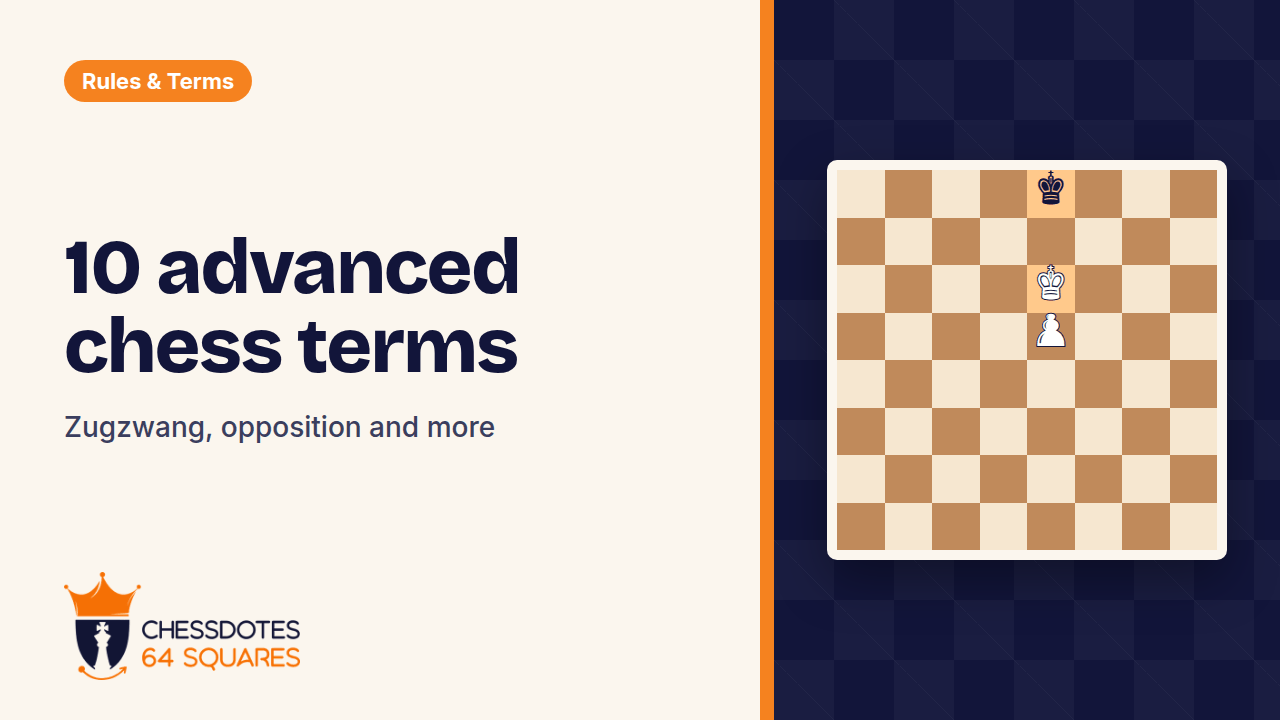
When the two kings stand on the same file with one square between them, they are in opposition. The player who does not have to move is said to “have the opposition”, because the other king must step aside. This decides many king and pawn endgames.
Black to move is in zugzwang: White has the opposition. Any black king move lets the white king advance, and the pawn promotes.
3. Zwischenzug
German for “in-between move”. Instead of making the obvious recapture, a player first plays a stronger move, often a check or a threat, and recaptures afterwards. Always ask: is there something even better before I recapture?
4. Prophylaxis
Prophylaxis means preventing your opponent’s plan before it happens. Strong players regularly ask, “What does my opponent want to do?” and play a move that stops it.
5. Tempo
A tempo is one move of time. Developing a piece while attacking an enemy piece “gains a tempo”, because the opponent must spend a move responding.
6. Outpost
An outpost is a square, usually in the opponent’s half, that enemy pawns can no longer attack. A knight on an outpost can be very powerful.
7 and 8. Passed and isolated pawns
Pawn structure
9. Fianchetto
Italian for “little flank”. The knight’s pawn moves one square (g3, b3, g6 or b6) and the bishop settles on the long diagonal. Openings like the King’s Indian Defence use it.
10. Initiative
Having the initiative means you are making the threats and your opponent is reacting. It is often worth a pawn or more, which is why gambits exist.
Coach’s tip: After each tournament game, try to find one of these ideas in your own game. Connecting terms to real positions is how they stick.
Frequently asked questions
Q. Is zugzwang only in endgames?
Mostly, but it can occur in middlegames too, especially in blocked positions.
Q. How do I get the opposition?
Place your king directly in front of the enemy king with one square between them, when it is the opponent’s turn to move.
Q. What is the difference between a zwischenzug and a blunder?
A zwischenzug is a deliberate, stronger in-between move. Forgetting to recapture is a blunder.
Q. Are isolated pawns always bad?
No. They can be weak in endgames but give active piece play in the middlegame.
Q. Where can I learn more?
Endgame and strategy lessons with a coach, plus solving positions that use these ideas.
Keep reading
Take your chess to the next level with our coaches.
Book a trial class at ChessDotes 64 Squares. Call or WhatsApp +91-9405520323.