
Most chess pieces move the same way every time. But there are three special moves that surprise beginners: castling, en passant and promotion. Each has exact rules, and getting them wrong in a tournament can cost a game.
In short
- Castling moves the king two squares towards a rook, and the rook jumps over.
- En passant lets a pawn capture an enemy pawn that has just moved two squares past it.
- A pawn reaching the last rank must be promoted to a queen, rook, bishop or knight.
- In tournaments, touch the king first when castling.
In this article
Castling
Castling is the only move where two pieces move at once. The king moves two squares towards one of its rooks, and that rook jumps to the square the king passed over.
After kingside castling (O-O): the king is on g1 and the rook on f1, safely behind the pawns.
You can castle only if
Kingside castling is written O-O; queenside castling is O-O-O. The rook may be attacked, and on the queenside the rook may pass over an attacked square (b1 or b8); only the king’s path matters.
Tournament tip: In a tournament, touch the king first and move it two squares, then move the rook, all with one hand. If you touch the rook first, you may not castle on that side and touch-move applies to the rook.
En passant
When a pawn moves two squares from its starting position and lands right beside an enemy pawn, that enemy pawn may capture it as if it had moved only one square. This capture is only allowed on the very next move. If you don’t do it immediately, the chance is gone.
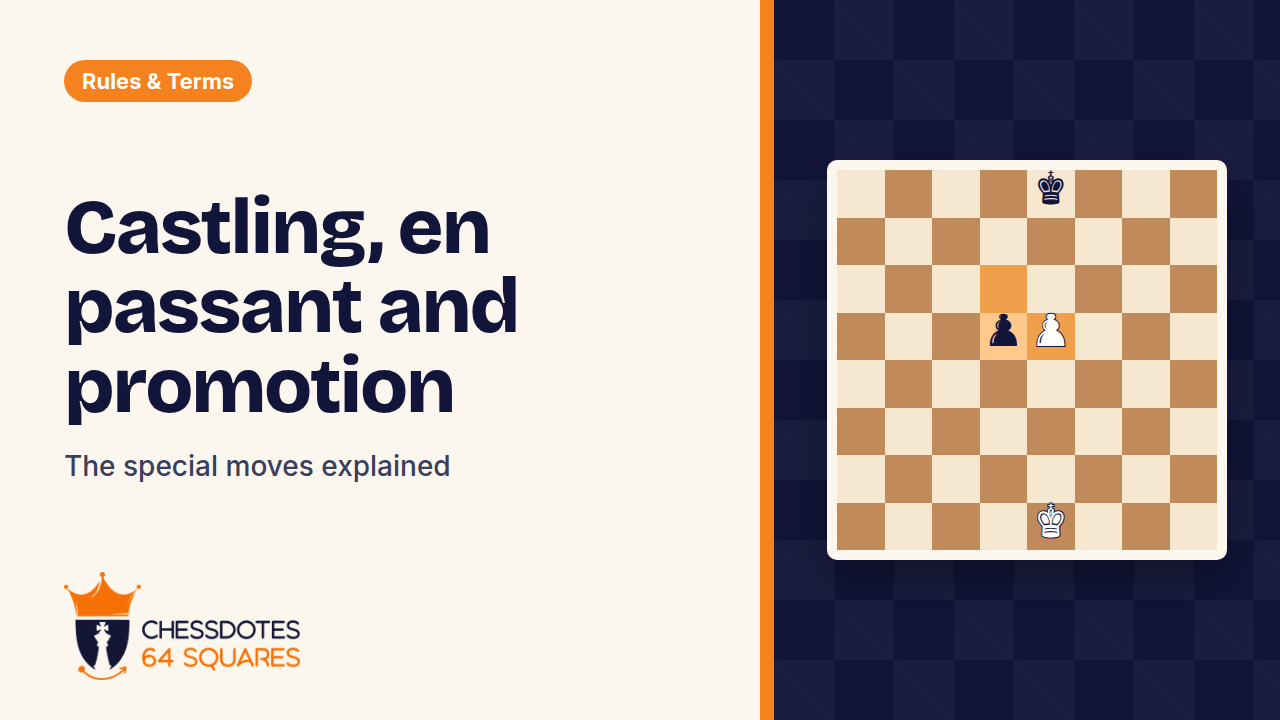
Black has just played …d7-d5. White’s pawn on e5 can capture en passant: exd6, landing on d6 and removing the pawn on d5.
How en passant works
An enemy pawn moves two squares
From its starting square, landing beside your pawn.
Your pawn is on its fifth rank
Rank 5 for White, rank 4 for Black.
Capture diagonally behind it
Move your pawn to the square the enemy pawn passed over.
Remove the captured pawn
Take the enemy pawn off the board.
Only on the next move
Wait one move and the right is lost.
Promotion
When a pawn reaches the last rank (the eighth rank for White, the first for Black), it must be replaced by a queen, rook, bishop or knight of the same colour. It can’t stay a pawn, and it can’t become a king. You can promote to a queen even if you still have your original queen.
White plays e8=Q, promoting the pawn to a queen.
Most players promote to a queen, but sometimes a knight (“underpromotion”) is better, for example to give check or to avoid stalemate.
Tournament tip: If no spare queen is available in a tournament, stop the clock and ask the arbiter for one. Under FIDE rules, an upside-down rook counts as a rook, not a queen.
Common mistakes
Avoid these
| Mistake | The rule |
|---|---|
| Castling out of check | Not allowed. Deal with the check first. |
| Castling after the king has moved and come back | Not allowed. The king has already moved. |
| Capturing en passant a move too late | Not allowed. It must be the very next move. |
| Leaving a pawn on the last rank as a pawn | Not allowed. It must be promoted. |
| Touching the rook first when castling | In tournaments you then can’t castle on that side. |
Frequently asked questions
Q. Can I castle if my rook is attacked?
Yes. Only the king’s squares matter.
Q. Can I castle out of check?
No. You must deal with the check another way first.
Q. Is en passant compulsory?
No, it’s optional, unless it is the only legal move.
Q. Can I have two queens?
Yes. You can promote to a queen even if your first queen is still on the board.
Q. Why would anyone promote to a knight?
Sometimes a knight gives check or a fork immediately, or a queen would stalemate the opponent.
Keep reading
Master every rule before your first tournament.
Book a trial class at ChessDotes 64 Squares. Call or WhatsApp +91-9405520323.