
A good chess tournament looks simple on the day, but a lot happens behind the scenes. Whether you run it yourself or hire us, here is everything to plan, from format and budget to prize distribution.
In short
- Fix format, date and budget 6 to 8 weeks ahead.
- Use a qualified arbiter and proper pairing software.
- Plan equipment: boards, sets, clocks and scoresheets.
- Publish results quickly and clearly on the day.
In this article
Tournament timeline
6 to 8 weeks before
Fix date, venue and format (rounds, time control, age groups). Set the budget and prizes.
4 to 6 weeks before
Publish the brochure and open registration. Book an arbiter and pairing software.
2 weeks before
Confirm boards, sets, clocks, tables, chairs, sound system and certificates.
Day before
Set up the hall, number the boards, test clocks, print registration lists.
Tournament day
Registration, opening, rounds on time, results and pairings displayed quickly, prize distribution.
After the event
Publish final results, share photos, thank sponsors.
1. Choose the format
Tournament formats
| Format | Best for | Rounds |
|---|---|---|
| Swiss | Large groups (20+ players) | 5 to 9 in a day with rapid time controls |
| Round-robin | Small groups (6 to 10 players) | Everyone plays everyone |
| Team event | Inter-school or inter-society | Teams of 4, Swiss or round-robin |
For a one-day school event, a Swiss tournament with a rapid time control (for example 15 minutes plus 5 or 10 seconds per move) usually fits 5 to 7 rounds comfortably.
2. Categories and prizes
Decide categories before announcing: age groups (Under-7, Under-9, Under-11, Under-13, and so on), best girl, best school, and so on. Clear categories keep prize distribution fair and avoid confusion.
3. Venue and equipment
Equipment checklist
| Item | How much you need |
|---|---|
| Tables and chairs | 1 table per board, 2 chairs |
| Boards and sets | 1 per 2 players, plus a few spare |
| Clocks | 1 per board (if using clocks) |
| Arbiters | At least 1 qualified arbiter; add assistants for larger events |
| Scoresheets | If notation is compulsory, 1 per player per round |
| Notice board or screen | For pairings and results |
| Sound system | For announcements |
| Prizes and certificates | Per categories, plus participation certificates |
4. Arbiters and pairings
A qualified arbiter keeps the event fair and solves disputes quickly. Pairings should be made with certified software like Swiss-Manager, which follows FIDE pairing rules. Publishing pairings and results online (for example on Chess-Results.com) lets parents follow along.
Organiser’s tip: Use a qualified arbiter and proper pairing software. It keeps pairings fair and saves arguments on the day.
5. A sample one-day schedule
Sample schedule (rapid Swiss, 6 rounds)
| Time | Activity |
|---|---|
| 8:00 | Registration and verification |
| 9:00 | Opening ceremony |
| 9:30 | Round 1 |
| 10:30 | Round 2 |
| 11:30 | Round 3 |
| 12:30 | Lunch |
| 13:30 | Round 4 |
| 14:30 | Round 5 |
| 15:30 | Round 6 |
| 16:30 | Prize distribution |
6. Budget
Main cost heads
| Budget item | Notes |
|---|---|
| Venue | Often free for schools and societies |
| Equipment | Hire, borrow or buy boards, sets and clocks |
| Arbiters | Fees per arbiter per day |
| Prizes and certificates | Trophies, medals, cash prizes, certificates |
| Refreshments | For players, arbiters and volunteers |
| Printing and publicity | Brochures, banners, scoresheets |
Common mistakes to avoid
Avoid these
How ChessDotes 64 Squares can help
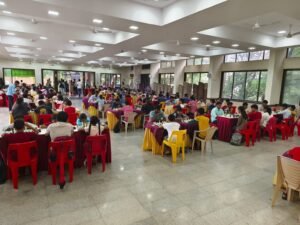
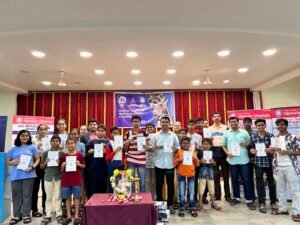
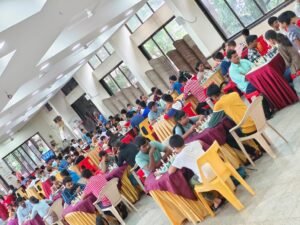
We manage tournaments end to end: planning, brochure, registration, arbiters, pairings, live results, prize lists and certificates. See our event management service and photos from past events.
Frequently asked questions
Q. How many players can a one-day tournament handle?
With enough boards and arbiters, 100 to 300 players in a rapid Swiss is common.
Q. Do we need a FIDE-rated event?
Not for most school events. Rated events have extra requirements and registration steps.
Q. How early should we start planning?
6 to 8 weeks ahead is comfortable for a school event.
Q. Can you supply equipment?
Chess Boards, Chess Clocks, DGT Chess Sets, Trophies & Medals
Q. What does event management cost?
It depends on size and requirements. Call or WhatsApp +91-9405520323 for a quote.
Keep reading
Planning a chess event? Let us run it for you.
Call or WhatsApp +91-9405520323 to discuss your date, venue and format.