Chess has its own language. Coaches, commentators and older players use words like fianchetto, zugzwang and j’adoube as if everyone knows them. This glossary explains the terms our students hear most, in plain English.
In short
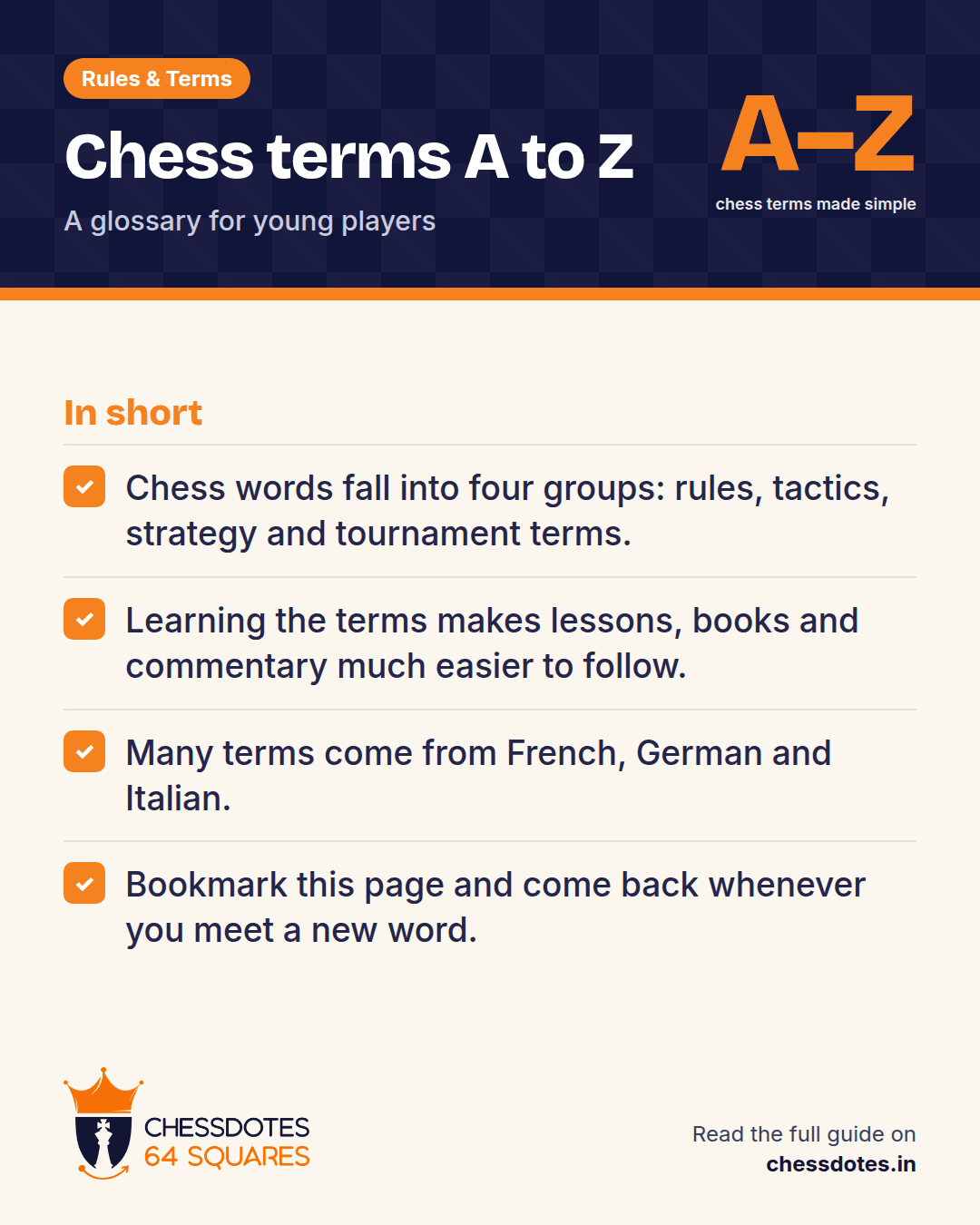
- Chess words fall into four groups: rules, tactics, strategy and tournament terms.
- Learning the terms makes lessons, books and commentary much easier to follow.
- Many terms come from French, German and Italian.
- Bookmark this page and come back whenever you meet a new word.
In this article
Rules and special moves
Rules
| Term | What it means |
|---|---|
| Check | The king is attacked. The player must get out of check on the next move. |
| Checkmate | The king is in check and has no legal way out. The game is over. |
| Stalemate | The player to move has no legal move but is not in check. The game is a draw. |
| Castling | A special move of king and rook together to make the king safe. |
| En passant | French for “in passing”. A special pawn capture right after an enemy pawn moves two squares. |
| Promotion | A pawn reaching the last rank becomes a queen, rook, bishop or knight. |
| Touch-move | If you deliberately touch a piece, you must move it (if you legally can). |
| J’adoube | French for “I adjust”. Said before straightening a piece on its square. |
Tactics
Tactics
| Term | What it means |
|---|---|
| Fork | One piece attacks two or more enemy pieces at once. |
| Pin | A piece can’t move without exposing a more valuable piece behind it. |
| Skewer | A valuable piece is attacked and must move, exposing the piece behind it. |
| Discovered attack | Moving one piece reveals an attack by another piece behind it. |
| Double check | Two pieces give check at once. Only a king move can answer it. |
| Sacrifice | Giving up material on purpose to gain something bigger. |
| Combination | A forcing sequence of moves, often with a sacrifice, that wins material or mates. |
| Zwischenzug | German for “in-between move”. A surprise move played before the expected reply. |
Strategy and position
Strategy
| Term | What it means |
|---|---|
| Development | Bringing pieces off the back rank and into play. |
| Fianchetto | Italian for “little flank”. Placing a bishop on b2, g2, b7 or g7 after moving the knight’s pawn. |
| Tempo | A unit of time: one move. Gaining a tempo means your opponent wastes a move. |
| Open file | A column with no pawns on it, ideal for rooks. |
| Outpost | A strong square for a piece, usually a knight, that enemy pawns can’t attack. |
| Passed pawn | A pawn with no enemy pawns in front of it or on the neighbouring files. |
| Isolated pawn | A pawn with no friendly pawns on the neighbouring files. |
| Zugzwang | German for “compulsion to move”. Any move worsens your position. |
Openings
Openings
| Term | What it means |
|---|---|
| Opening | The first phase of the game, roughly the first 10 to 15 moves. |
| Gambit | An opening that offers a pawn (or more) for quick development or attack. |
| Theory | Well-known, tested opening moves. |
| Repertoire | The set of openings a player chooses to play regularly. |
Tournament terms
Tournament
| Term | What it means |
|---|---|
| Arbiter | The official who applies the rules and settles disputes. |
| Time control | How much time each player has, e.g. 90 min + 30 sec per move. |
| Increment | Seconds added to your clock after each move you make. |
| Flag fall | Running out of time on the clock. |
| Pairing | Who plays whom in a round. |
| Bye | A round without an opponent, usually when there’s an odd number of players. |
| Tiebreak | A rule deciding places between players on the same score. |
| Rating | A number measuring playing strength, such as a FIDE rating. |
Everyday chess slang
Slang
| Term | What it means |
|---|---|
| Blunder | A serious mistake, often losing a piece or the game. |
| Hanging piece | A piece left undefended and free to capture. |
| Swindle | Winning or drawing from a lost position with a trick. |
| Patzer | A friendly (or not so friendly) word for a weak player. |
Coach’s tip: Learn five new terms a week and use them when you talk about your games. Our advanced terms guide explains the trickier ones with diagrams.
Frequently asked questions
Q. What does “en passant” mean?
It is French for “in passing”, a special pawn capture. See our guide to special moves for how it works.
Q. What is the difference between checkmate and stalemate?
In checkmate the king is in check and can’t escape: the game is lost. In stalemate the king is not in check but there’s no legal move: it’s a draw.
Q. Why are so many chess words French or German?
Modern chess rules and literature developed in Europe, and many terms stuck in their original language.
Q. What is a fianchetto?
Developing a bishop onto the long diagonal after moving the knight’s pawn one square, for example g3 and Bg2.
Q. Do I need to know all these words to play well?
No, but knowing them makes lessons and books much easier to follow.
Keep reading
Learn the language of chess with our coaches.
Book a trial class at ChessDotes 64 Squares. Call or WhatsApp +91-9405520323.