
Every tournament game is a free lesson, but only if you look at it afterwards. Strong players review almost every serious game they play. Here is the simple method our students use.
In short
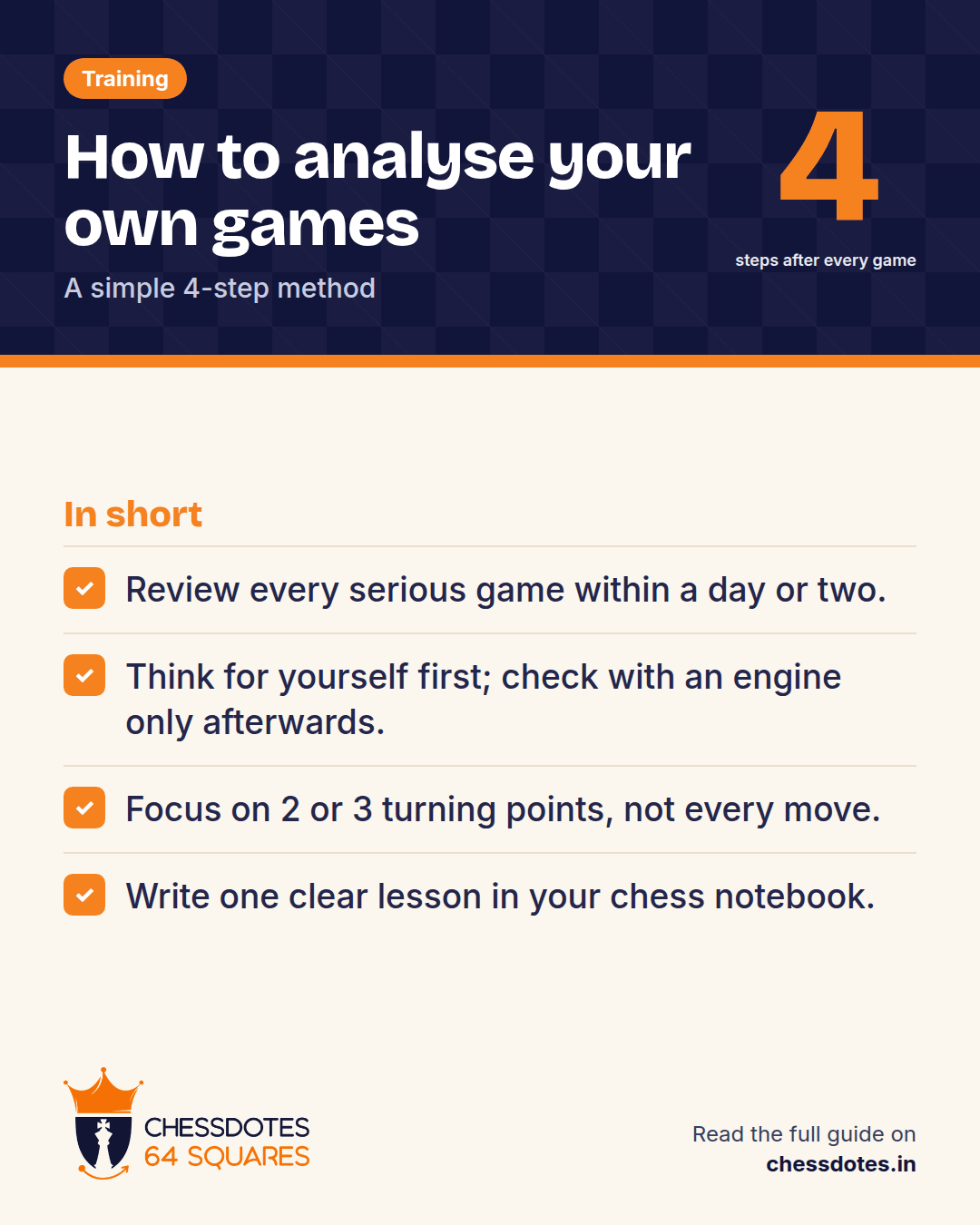
- Review every serious game within a day or two.
- Think for yourself first; check with an engine only afterwards.
- Focus on 2 or 3 turning points, not every move.
- Write one clear lesson in your chess notebook.
In this article
Why analysing your own games matters
Puzzles and lessons teach general ideas. Your own games show your personal weaknesses: the openings you misplay, the tactics you miss, the endgames you don’t know. Reviewing them is the most targeted training there is.
The 4-step review
Review it yourself first
Play through the game on a real board using your scoresheet. Mark moves where you were unsure and write what you were thinking.
Find the turning points
Where did the game change? Where did a piece get lost, or a chance get missed?
Then check with an engine
Only after your own review. See whether the engine agrees with your critical moments.
Write one lesson
Record it in your chess notebook, as a rule you can use next time.
Step 1: Review it yourself first
Right after the tournament, while the game is fresh, replay it from the scoresheet. At each important moment, write down what you were thinking: “I thought my knight was safe” or “I didn’t see his bishop”. This is valuable information that an engine can never give you.
Step 2: Find the turning points
Most games have two or three moments that decided the result: a missed tactic, a bad plan, a time-trouble blunder. Mark them. You don’t need to analyse every move equally.
Questions for each phase
| Game phase | Questions to ask |
|---|---|
| Opening | Did I follow the principles? Where did I leave known moves? Was I comfortable after 10 moves? |
| Middlegame | What was my plan? Did I miss any tactics for either side? When did the evaluation change? |
| Endgame | Did I know the technique? Did I use my king actively? Did I convert or defend correctly? |
| Clock | Where did I spend too much or too little time? |
Step 3: Check with an engine, carefully
Engines like Stockfish are incredibly strong, but they show numbers, not reasons. Use them to check the moments you already marked. When the engine suggests a different move, try to understand why it’s better. If you can’t, ask your coach.
Good review vs weak review
Step 4: Write one lesson
“I blundered” is not a lesson. “Before moving my queen, check for knight forks” is. Write one or two rules per game in your chess notebook, and reread the notebook before your next tournament.
Spotting patterns over time
After ten or more reviewed games, look through your notebook. You will usually see the same mistakes again and again: maybe weak endgames, maybe missing opponent threats, maybe time trouble. That tells you and your coach exactly what to work on next.
Coach’s tip: Losses teach the most. Review them first, even when it’s not fun. Wins deserve a look too: sometimes you won despite a mistake.
Frequently asked questions
Q. Should children use engines?
Yes, after their own review and preferably with a coach’s guidance.
Q. How long should a review take?
15 to 30 minutes for a tournament game is plenty for most juniors.
Q. What if my child didn’t write notation?
Reconstruct the key moments from memory as best they can, and encourage notation next time.
Q. Is it better to review alone or with a coach?
Both. Review alone first, then go through the key moments with the coach.
Q. How do I get my games into a computer?
Enter the moves into Lichess’s analysis board or ChessBase. Many events also publish games as PGN.
Bring your scoresheets to class and your coach will go through the key moments with you.
Keep reading
Get your games reviewed by a coach.
Book a trial class at ChessDotes 64 Squares. Call or WhatsApp +91-9405520323.