
Many young players know how the pieces move but still lose points because they don’t know tournament rules. These are the rules that come up in almost every event, explained the way we teach them in class.
In short
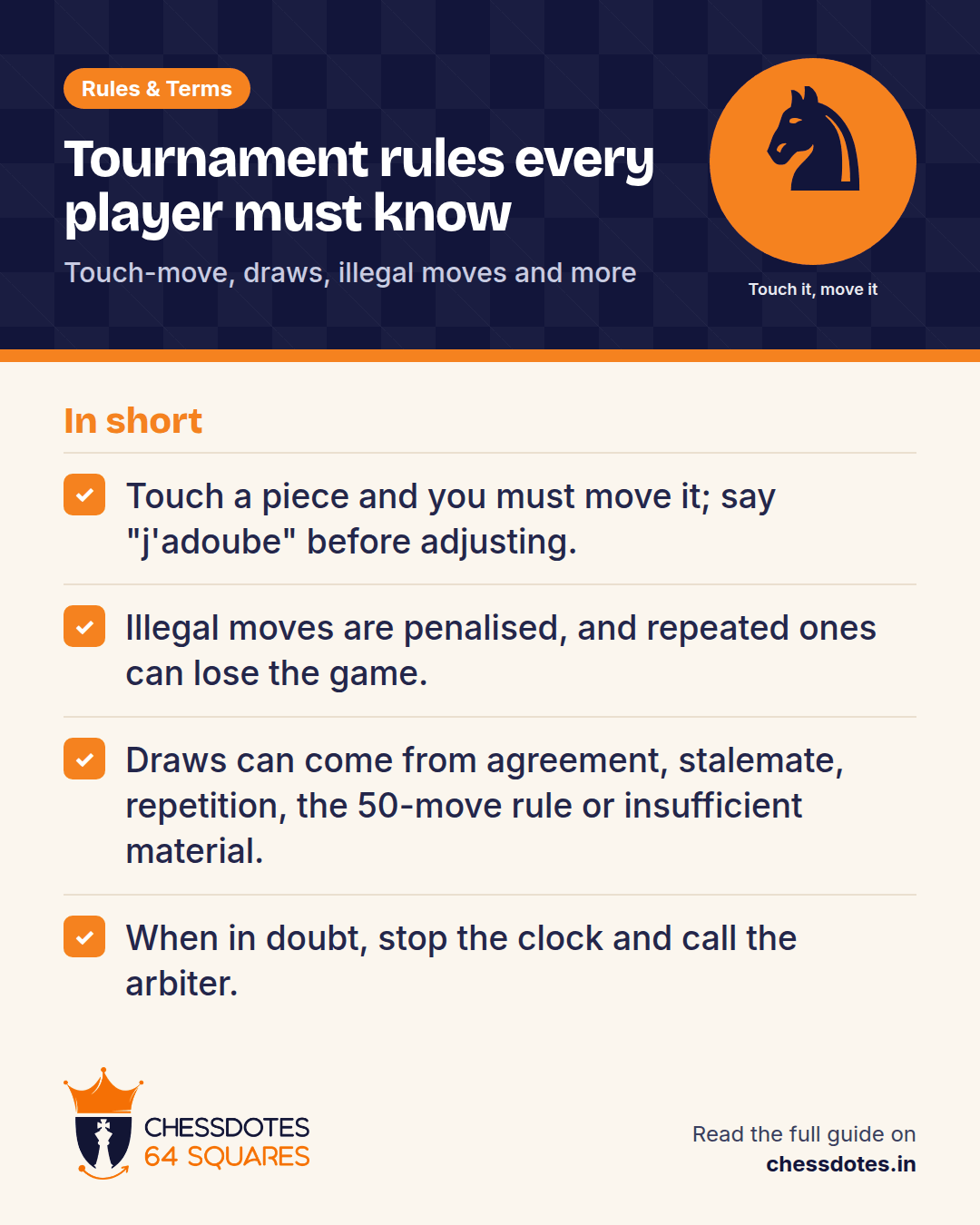
- Touch a piece and you must move it; say “j’adoube” before adjusting.
- Illegal moves are penalised, and repeated ones can lose the game.
- Draws can come from agreement, stalemate, repetition, the 50-move rule or insufficient material.
- When in doubt, stop the clock and call the arbiter.
In this article
The key rules at a glance
Touch-move
Touch your own piece: move it. Touch an opponent’s piece: capture it, if legal.
J’adoube
Say it before straightening a piece, and only on your turn.
Illegal moves
Penalised with extra time for the opponent. Repeat it and you can lose.
Draw offers
Move, offer, then press the clock.
50-move rule
No capture or pawn move in 50 moves each: claim a draw.
Repetition
Same position three times: claim a draw.
Touch-move
If a player deliberately touches one of their own pieces, they must move it, as long as it has a legal move. If they deliberately touch an opponent’s piece, they must capture it if they legally can. Once a piece is released on a square, the move is made and cannot be changed.
If a player touches a piece that has no legal move, there is no penalty and they may play any other move. Accidental touches, like brushing a piece with a sleeve, do not count.
Coach’s tip: Decide on your move first, then touch the piece. Some players literally sit on their hands until they are sure.
J’adoube: adjusting pieces
If a piece is not centred on its square, you may straighten it, but only on your own turn, and only after saying “j’adoube” or “I adjust” before touching it. Without the warning, touch-move applies, even if you only meant to straighten the piece.
Illegal moves
An illegal move is any move that breaks the rules, such as leaving your own king in check or moving a piece incorrectly. If an illegal move is completed (the player presses the clock), the arbiter restores the position from just before it.
Illegal move penalties
| Situation | What usually happens (standard games) |
|---|---|
| First illegal move | The position is restored and the opponent gets 2 extra minutes |
| Second illegal move by the same player | The game is lost (unless the opponent cannot checkmate by any series of legal moves, then it is a draw) |
| Rapid and blitz | Similar principles, but check the event’s rules and FIDE’s rapid and blitz appendix |
Before pressing the clock, always ask: is my king in check after this move?
How to offer a draw correctly
Offering a draw
Make your move
Offer only after you have played your move on the board.
Offer the draw
Say clearly, “I offer a draw.”
Press the clock
Now it is your opponent’s decision.
Don’t repeat it
Repeated offers can be treated as disturbing your opponent.
The ways a game can be drawn
How games are drawn
| Draw type | What it means | Automatic or claimed? |
|---|---|---|
| Agreement | Both players agree to a draw | Agreed |
| Stalemate | The player to move has no legal move and is not in check | Automatic |
| Threefold repetition | The same position occurs three times with the same player to move | Claimed (automatic at five times) |
| 50-move rule | 50 moves by each player with no capture and no pawn move | Claimed (automatic at 75) |
| Insufficient material | Neither side can possibly checkmate, e.g. king against king | Automatic |
The 50-move rule
This rule matters most in endgames, for example when one side has an extra piece but cannot find the mate. The claim is made to the arbiter, usually by writing the intended move on the scoresheet and stopping the clock. After 75 moves each without a capture or pawn move, the game is drawn automatically.
Threefold repetition
The repeats do not need to be in a row. Castling and en passant rights must also be the same. To claim, a player writes the move that will repeat the position on the scoresheet, declares the intention to the arbiter, and stops the clock, or claims when the position has just appeared for the third time.
Clock and scoresheet rules
- Press the clock with the same hand that moved the piece.
- Don’t keep your hand hovering over the clock.
- In standard games, you usually must write every move. Write your move after making it, not before.
- If your time runs out, the opponent can claim the win (unless they cannot checkmate by any legal sequence, then it is a draw).
Castling rules that trip up beginners
Castling checklist
The golden rule: If you are unsure about anything during a game, stop the clock and call the arbiter. Never argue with your opponent. The arbiter’s job is to apply the rules fairly.
Frequently asked questions
Q. If I touch a piece by accident, do I have to move it?
No. Touch-move applies only to deliberate touches.
Q. Can I take back a move if I haven’t pressed the clock?
No. Once you release the piece on a legal square, the move is made.
Q. Can my parent or coach call the arbiter for me?
No. Only the players (and arbiters) can act during the game. Your child should raise a hand.
Q. Does stalemate count as a win?
No. Stalemate is a draw.
Q. What if my opponent keeps offering draws?
Tell the arbiter. Repeated offers can be treated as disturbing an opponent.
Keep reading
Our students learn the rules before their first tournament.
Book a trial class at ChessDotes 64 Squares. Call or WhatsApp +91-9405520323.