Many beginners reach a winning position and then cannot finish the game, or worse, they stalemate the opponent. These checkmate patterns turn winning positions into wins, and protect you from losing quickly.
In short
- Checkmate means the king is in check and has no legal escape.
- Every player must be able to mate with king + queen and king + rook.
- Back-rank mates and scholar’s mate decide many junior games.
- Watch out for stalemate when you are winning.
In this article
What exactly is checkmate?
Checkmate happens when a king is in check and there is no legal way to get out of it. There are only three ways to escape check: move the king, block the check, or capture the checking piece. If none works, it’s checkmate and the game is over.
Don’t confuse the two
1. King and queen mate
The most important basic endgame. Use the queen to push the enemy king to the edge of the board, then bring your own king close to support the final check. Be careful near the end: a careless queen move can leave the enemy king with no moves while not in check, which is stalemate.
Checkmate: the queen on b7 is protected by the king on b6, and the black king has no escape.
Queen mate method
Box the king
Use the queen, a knight’s move away from the enemy king, to shrink its space.
Push to the edge
Keep shrinking the box until the king is on the edge.
Bring your king
Walk your king up to help. Watch out for stalemate.
Deliver mate
The queen gives check on the edge, protected by your king.
2. King and rook mate
Harder than the queen mate, but essential. The rook cuts off the enemy king rank by rank (or file by file) until it reaches the edge. The two kings face each other, and the rook delivers mate on the edge. Every tournament player should be able to do this within the 50-move limit.
3. Back-rank mate
When a king is stuck behind its own pawns on the back rank, a rook or queen landing on that rank can deliver mate. It is one of the most common ways games end at every level.
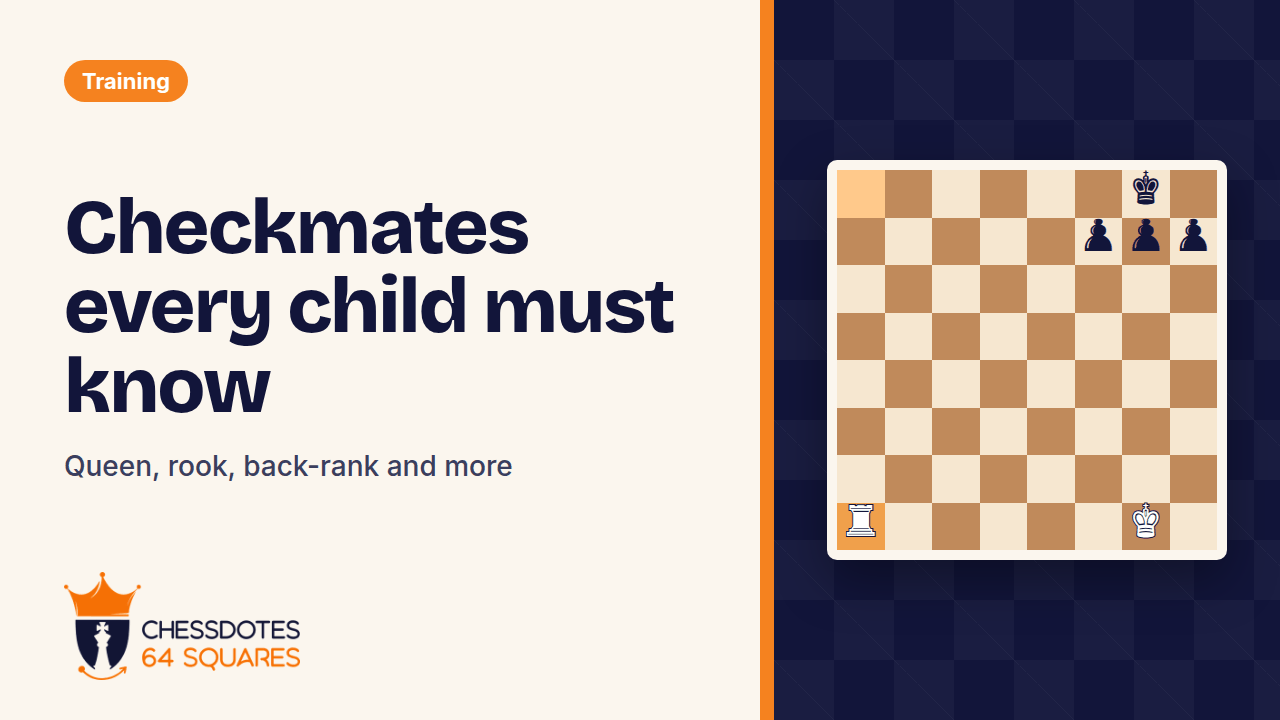
White plays Ra8 and it is checkmate. The black king is trapped by its own pawns.
Defence tip: Give your king an escape square (a move like h3 or h6) once the position settles, so a back-rank mate can’t happen to you.
4. Scholar’s mate (and how to stop it)
A quick trap where queen and bishop attack the f7 pawn (or f2 for White), which is defended only by the king at the start. It works only against beginners, but almost every child meets it at least once.
White plays Qxf7, checkmate. Black should have defended with …g6 or …Qe7 instead of …Nf6.
The defence is simple: when you see the queen and bishop both aiming at f7, protect it (for example with …Qe7 or block with …g6), and then develop your pieces with tempo by attacking the queen.
5. Smothered mate
A beautiful pattern where a knight checkmates a king that is completely surrounded by its own pieces, so it has no squares to escape to. It usually happens in the corner, with the king on h8 (or a8) boxed in by its rook and pawns.
How to practise checkmates
Checkmate practice checklist
| Pattern | Practice goal |
|---|---|
| King + queen vs king | Mate in under 10 moves, every time, without stalemate |
| King + rook vs king | Mate within the 50-move limit |
| Back-rank mate | Spot it for both sides in puzzles |
| Scholar’s mate | Defend it confidently as Black |
| Smothered mate | Recognise the pattern in puzzles |
Frequently asked questions
Q. Why does my child keep stalemating instead of winning?
Usually the queen takes away the king’s last squares without giving check. Practise the queen mate slowly, watching the enemy king’s moves.
Q. Is scholar’s mate a good opening for beginners?
No. Against careful players it fails and leaves the queen exposed. Learn it to defend against it.
Q. How long should the rook mate take?
With practice, around 15 to 25 moves. It must be done within the 50-move rule.
Q. Can you checkmate with two knights?
Not by force against a lone king. King and two knights cannot force mate.
Q. Can you checkmate with a bishop and knight?
Yes, but it is an advanced technique usually learned later.
Keep reading
Master the basics with a coach.
Book a trial class at ChessDotes 64 Squares. Call or WhatsApp +91-9405520323.