At beginner and club level, most games are decided by tactics: short, forcing sequences that win material or deliver checkmate. Learn to spot these five patterns and you will start winning pieces instead of losing them.
In short
- A tactic is a short, forcing sequence that wins material or mates.
- The big five: fork, pin, skewer, discovered attack, double check.
- Tactics come from targets: undefended pieces and an exposed king.
- Daily puzzles are the fastest way to get better at tactics.
In this article
Know the value of the pieces
Tactics are about winning material, so you need to know what each piece is worth. These values are a guide, not a rule, but they help you decide whether a trade is good.
Standard piece values (points)
1. The fork
One piece attacks two or more enemy pieces at the same time. The opponent can save only one. Knights are famous for forks because they jump and attack in unusual patterns, but every piece, even a pawn, can fork.
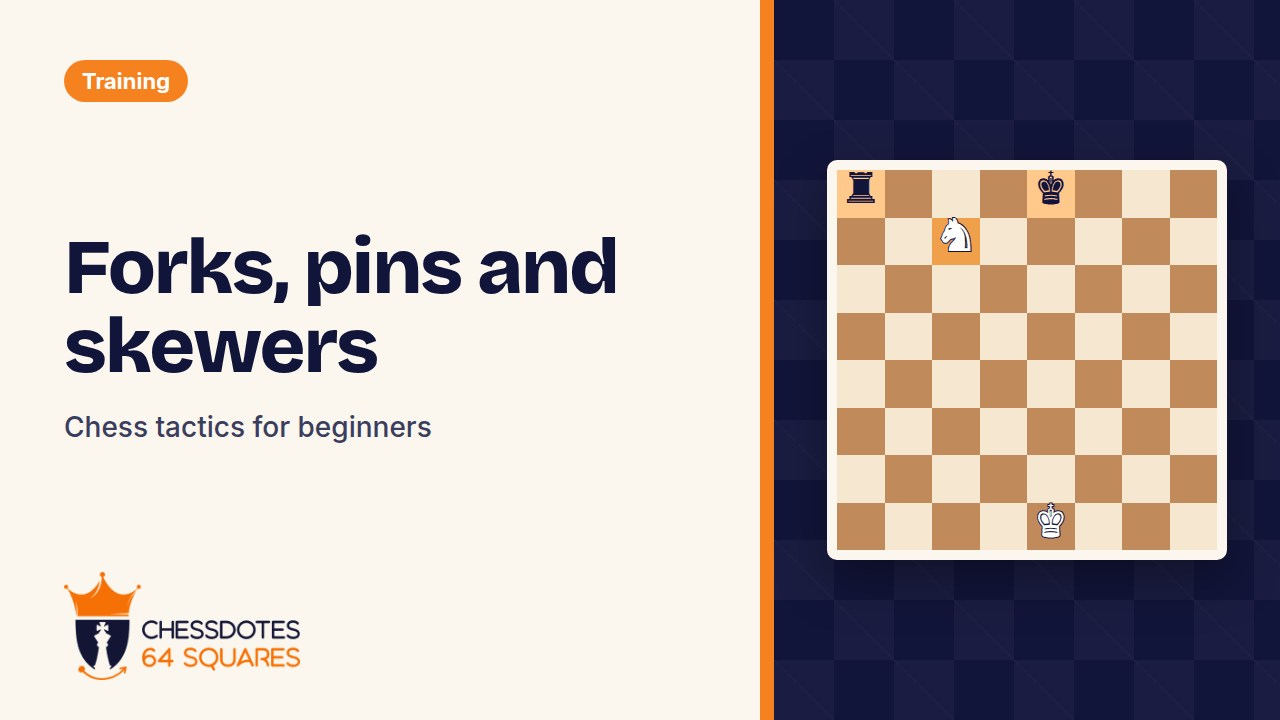
The white knight on c7 attacks the king on e8 and the rook on a8. After the king moves, White takes the rook.
How to spot forks: Look for enemy pieces on the same colour squares a knight’s jump apart, especially the king and queen or king and rook.
2. The pin
A piece cannot move (or should not move) because a more valuable piece stands behind it on the same line. If the piece behind is the king, it is an absolute pin: moving is illegal. Otherwise it is a relative pin: moving is legal but costly.
The bishop on b5 pins the knight on c6 to the king on e8. The knight cannot move.
Once a piece is pinned, attack it again. A pinned piece often cannot escape or be defended in time.
3. The skewer
The reverse of a pin: a valuable piece is attacked, moves out of the way, and the piece behind it is captured. Skewers usually involve long-range pieces: rooks, bishops and queens.
The rook on a1 checks the king on a5. The king must move off the file, and the rook captures the queen on a8.
4. The discovered attack
One piece moves out of the way and reveals an attack by another piece behind it. The moving piece can make its own threat at the same time, so the opponent faces two threats at once. If the revealed attack is a check, it is called a discovered check, and it is one of the most powerful tactics in chess.
5. The double check
The king is attacked by two pieces at once, usually through a discovered check where the moving piece also gives check. The only legal reply is a king move, because you cannot block or capture two checking pieces at the same time. Double checks often lead to checkmate.
Quick memory card
Fork
One attacker, two targets
Pin
Front piece can’t move without exposing a bigger one
Skewer
Big piece in front is forced away
Discovered attack
Moving one piece unleashes another
Double check
Two checks at once: the king must move
How to find tactics in your own games
Tactics scan
How to practise tactics
Tactics practice plan
| Level | Daily puzzles | Focus |
|---|---|---|
| Beginner | 5 to 10 | One-move tactics: forks, pins, mate in one |
| Improving | 10 to 15 | Two-move combinations, discovered attacks |
| Tournament player | 15 to 20 | Longer combinations, calculating without moving pieces |
Frequently asked questions
Q. How many puzzles should my child solve each day?
Quality matters more than quantity. 5 to 15 carefully solved puzzles a day is excellent.
Q. Which tactic should beginners learn first?
The fork, then the pin. They are the most common in beginner games.
Q. Why does my child spot tactics in puzzles but not in games?
In puzzles you know a tactic exists. In games, the tactics scan helps you look for them every move.
Q. Are piece values always correct?
They are a guide. Position matters too: an active knight can be stronger than a passive rook.
Q. Is there a book you recommend?
Winning Chess Tactics by Yasser Seirawan
Keep reading
Our puzzle sets are matched to each student’s level.
Book a trial class at ChessDotes 64 Squares. Call or WhatsApp +91-9405520323.