
Tournament brochures say things like “90 minutes + 30 seconds” or “15+10”. Here is what those numbers mean, how the chess clock works, and which time controls help young players improve fastest.
In short
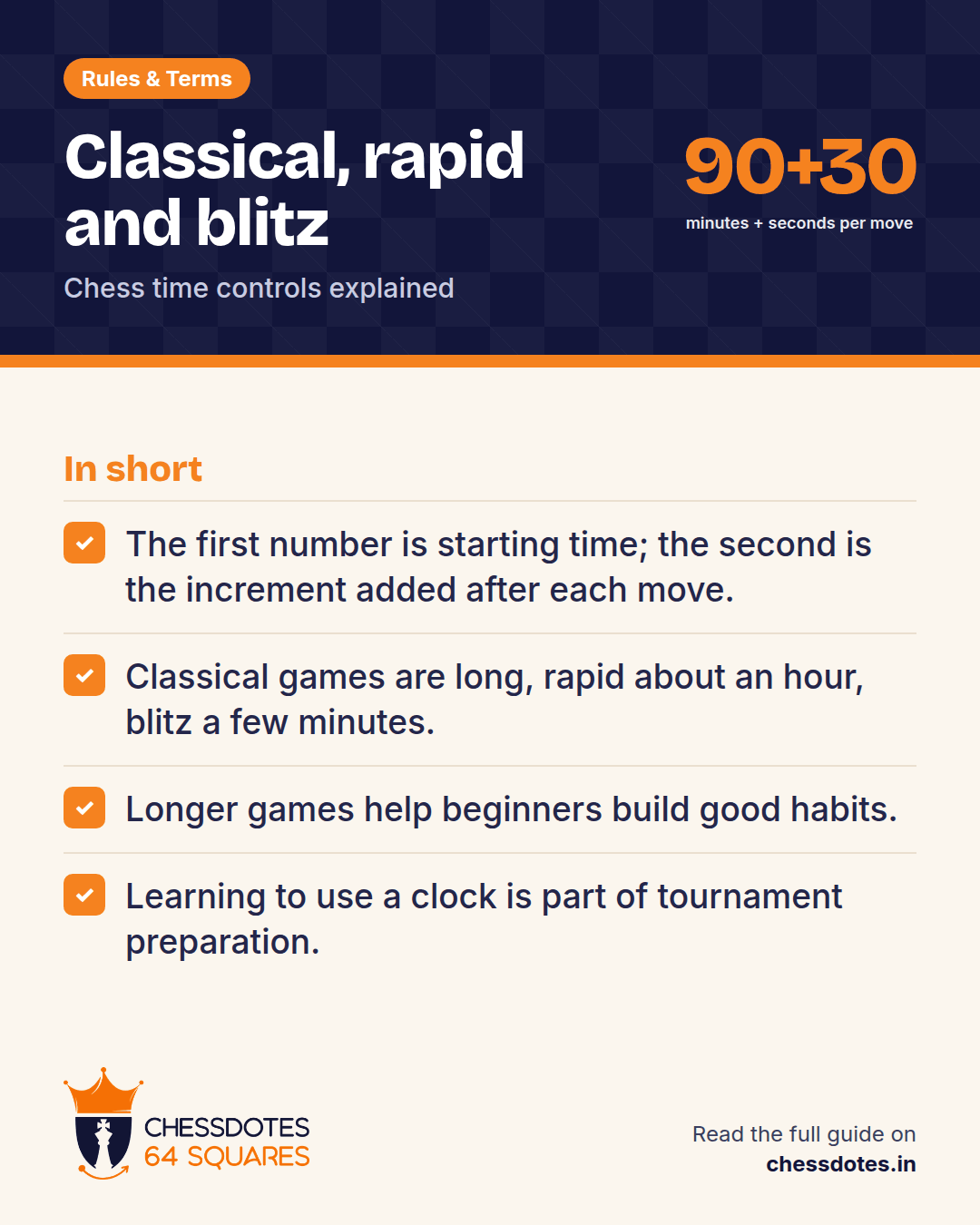
- The first number is starting time; the second is the increment added after each move.
- Classical games are long, rapid about an hour, blitz a few minutes.
- Longer games help beginners build good habits.
- Learning to use a clock is part of tournament preparation.
In this article
How to read a time control
A time control like 90+30 means each player starts with 90 minutes, and 30 seconds are added to their clock after every move they make (the increment). Some classical events also add extra time after move 40, written like “90 min for 40 moves + 30 min + 30 sec per move from move 1”.
The three main time controls
| Type | Typical time control | Game length | Rated as |
|---|---|---|---|
| Classical (standard) | 90 min + 30 sec per move | 3 to 5 hours | FIDE standard rating |
| Rapid | 15 min + 10 sec per move | About 1 hour | FIDE rapid rating |
| Blitz | 3 min + 2 sec per move | About 10 to 15 minutes | FIDE blitz rating |
FIDE categories, roughly (time for 60 moves, including increments)
Increment vs no increment
Without an increment (like “30 minutes, no increment”), a player can lose on time even in a winning position, and endings become a race. With an increment, every move adds a little time, so a player can always make moves if they play quickly enough. Most FIDE-rated events use increments.
Clock rules to know
Using the clock
Time management tips
Managing your clock
Play the opening at a steady pace
Don’t burn 20 minutes on move 5.
Invest time at critical moments
When pieces are exchanged, when the position opens, or when making a plan.
Keep a buffer
Aim to reach move 30 or 40 with reasonable time left.
Use the increment
In time trouble, make safe moves quickly and bank the increment.
Which time control helps children improve?
Longer games. They give time to think, apply the blunder check and make plans. Rapid is a good middle ground for young players. Blitz is fun, but too much of it builds fast, careless habits, especially for beginners.
Classical vs blitz for learning
Coach’s tip: Practise with a real clock at home. Many children lose tournament games on time simply because they are not used to pressing the clock.
Frequently asked questions
Q. What does “G/60” mean?
Each player has 60 minutes for the whole game, with no increment.
Q. Can my child lose on time in a winning position?
Yes, if the opponent can still checkmate by some legal sequence. That’s why time management matters.
Q. Should beginners play blitz?
A little, for fun. Most practice should be longer games.
Q. Are rapid and blitz ratings separate?
Yes. FIDE publishes separate standard, rapid and blitz ratings.
Q. What clock should we buy for home?
Any simple digital clock that supports increments is ideal.
Keep reading
Get comfortable with the clock before tournaments.
Book a trial class at ChessDotes 64 Squares. Call or WhatsApp +91-9405520323.