
Parents hear numbers like 1450 or 1800 all the time. What do they mean? Why is a child’s Chess.com rating so different from their FIDE rating? Here is a clear guide to how chess ratings work.
In short
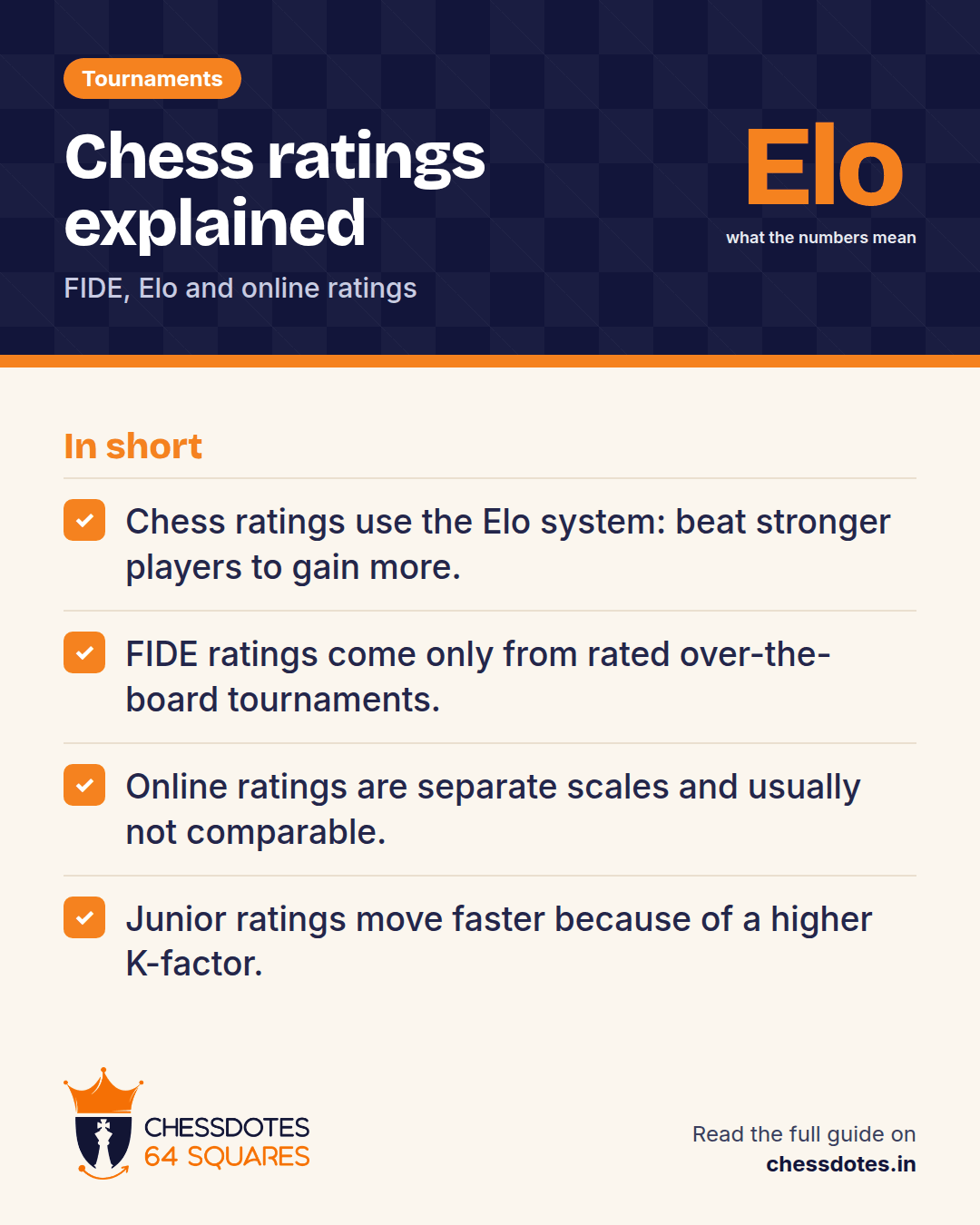
- Chess ratings use the Elo system: beat stronger players to gain more.
- FIDE ratings come only from rated over-the-board tournaments.
- Online ratings are separate scales and usually not comparable.
- Junior ratings move faster because of a higher K-factor.
In this article
How the Elo system works
Chess ratings are based on the Elo system, named after Arpad Elo. Every player has a number. When two players meet, their rating difference predicts the expected score. Beat a stronger player and you gain a lot of points; lose to a weaker player and you lose a lot. Over many games, the number settles near your true playing strength.
The Elo idea in 4 steps
Before the game
Both ratings give an expected score for each player.
After the game
The actual result is compared with the expected score.
Rating change
Scored more than expected: rating goes up. Less: it goes down.
Size of change
Depends on the K-factor, which is larger for newer and younger players.
What rating gaps mean
| Rating difference | Stronger player’s expected score |
|---|---|
| 0 | 50% |
| 100 | About 64% |
| 200 | About 76% |
| 400 | About 91% |
What is the K-factor?
The K-factor controls how much a rating changes after each game. FIDE currently uses a higher K-factor for new players and juniors, so their ratings respond quickly as they improve. Established adult players have a lower K-factor, so their ratings move more slowly.
K-factor at a glance
| Player | FIDE K-factor (current rules) |
|---|---|
| New players (first 30 games) and juniors under 18 rated below 2300 | 40 |
| Players rated below 2400 | 20 |
| Players who have reached 2400 | 10 |
FIDE updates these rules from time to time, so check the latest rating regulations if the details matter for you.
FIDE ratings vs online ratings
FIDE vs online ratings
Because online sites use different starting ratings and player pools, a 1500 on one site is not the same as a 1500 on another, or a 1500 FIDE. Compare a player’s progress on the same scale over time.
What is a “good” rating?
A rough guide to FIDE ratings
| FIDE rating | Roughly means |
|---|---|
| 1400 to 1600 | A solid club player who knows the basics well |
| 1600 to 1900 | A strong club and district-level player |
| 1900 to 2200 | A strong state-level competitive player |
| 2200+ | Expert level; titles like CM, FM, IM and GM start around here |
For a child, the most meaningful number is not the rating itself but the trend. A steady rise over a year means the training is working.
Chess titles
FIDE titles
| Title | Full name |
|---|---|
| CM | Candidate Master |
| FM | FIDE Master |
| IM | International Master |
| GM | Grandmaster |
| WCM / WFM / WIM / WGM | Women’s titles at the matching levels |
For parents: Don’t compare your child’s online rating with a friend’s FIDE rating. They are different scales. Track progress on one scale over months.
Frequently asked questions
Q. Why did my child’s rating drop after a good tournament?
Ratings depend on results relative to expectations. Scoring 4/7 against weaker opposition can still lose points.
Q. How often are FIDE ratings updated?
Monthly.
Q. Can ratings go below 1400?
The lowest published FIDE rating is currently 1400.
Q. Is there a separate Indian rating?
Rated events in India count towards FIDE ratings. AICF registration is required to play them.
Q. How fast can a child’s rating rise?
Juniors with a K-factor of 40 can gain quickly with good results, sometimes 100+ points in one strong event.
Keep reading
Want a plan to raise your child’s rating?
Book a trial class at ChessDotes 64 Squares. Call or WhatsApp +91-9405520323.