
Classes give children new ideas. Home practice turns those ideas into skill. The good news: 20 focused minutes a day is enough to see real progress. Here is the routine we give our students, and how parents can make it stick.
In short
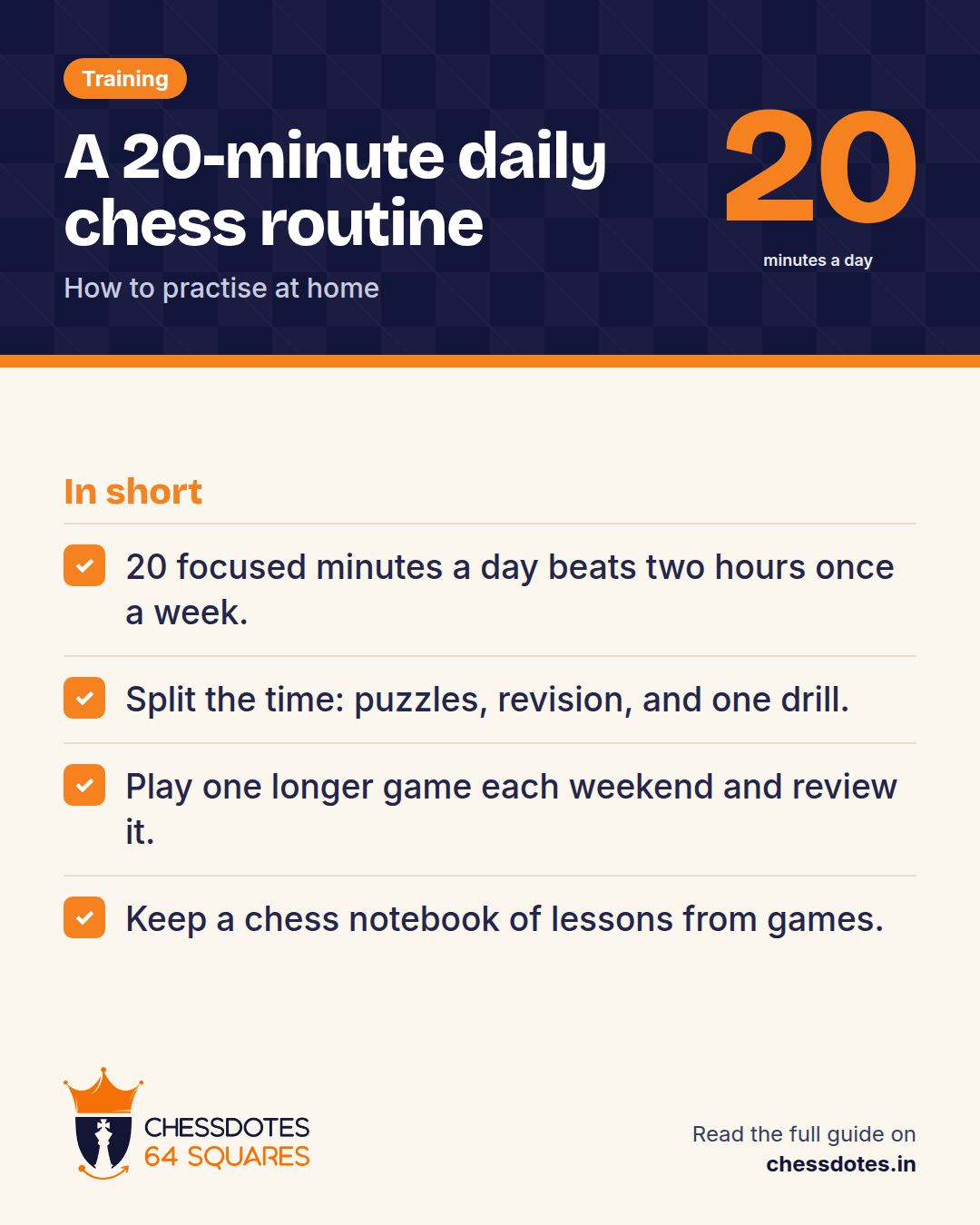
- 20 focused minutes a day beats two hours once a week.
- Split the time: puzzles, revision, and one drill.
- Play one longer game each weekend and review it.
- Keep a chess notebook of lessons from games.
In this article
Why daily practice works
Chess skill is mostly pattern recognition. Strong players have seen thousands of positions and recognise tactics and plans almost instantly. The only way to build that library is regular repetition. Short daily practice keeps patterns fresh; long gaps mean children forget what they learned.
The daily 20-minute routine
| Time | Activity | Why it works |
|---|---|---|
| 10 min | Solve 5 to 10 tactics puzzles | Builds pattern recognition, the biggest skill at club level |
| 5 min | Revise one idea from class | Repetition fixes a lesson in memory |
| 5 min | Play out one endgame or checkmate drill against a parent or app | Turns knowledge into technique |
Part 1: Puzzles (10 minutes)
Puzzles are the single most useful thing a young player can practise. Start with puzzles slightly below your level so that you solve most of them, and slowly make them harder.
How to solve puzzles well
Part 2: Revise one idea (5 minutes)
Look at your class notes or homework and set up one position from the lesson. Explain it to a parent, as if you were the coach. Teaching an idea is the fastest way to understand it.
Part 3: One drill (5 minutes)
Pick one skill and repeat it until it becomes automatic. Good drills for beginners and intermediates:
- Checkmate with king and queen against king, as fast as possible
- Checkmate with king and rook against king
- King and pawn against king: can you promote?
- Play an opening position and develop all pieces in 8 moves
A sample week
Weekly plan
| Day | Focus |
|---|---|
| Monday | Puzzles + forks and pins |
| Tuesday | Puzzles + class revision |
| Wednesday | Puzzles + checkmate drill |
| Thursday | Puzzles + class revision |
| Friday | Puzzles + endgame drill |
| Saturday | One longer game (15+ minutes each) |
| Sunday | Review Saturday’s game, update notebook |
Keep a chess notebook
After every serious game, write down four things: the opening, one good move, one mistake and one lesson. After a few months, this notebook becomes the best study material your child owns, because it is built from their own games.
Screen time and online chess
Online chess is useful for practice and puzzles, but very fast games (1 to 3 minutes) build careless habits in beginners. Encourage games of 10 minutes or more, and a few thoughtful games rather than many quick ones. Always prefer playing against real people you know, or on child-safe settings.
How parents can help
Frequently asked questions
Q. My child resists practice. What should I do?
Keep it short and fixed, like brushing teeth. Let them choose puzzles, and praise effort. Even 10 minutes is better than nothing.
Q. Which app or website is good for puzzles?
Lichess (free) and Chess.com both have puzzle sections. Ask your coach for level-appropriate sets.
Q. Can I help if I don’t play chess?
Yes. Ask your child to explain the lesson to you, and play simple games together.
Q. Should practice increase before tournaments?
Slightly. More longer games and game reviews in the two weeks before an event help most.
Q. Is a physical board necessary?
It helps a lot, especially for young children. Tournaments are played on real boards.
Keep reading
Our students get weekly homework matched to their level.
Book a trial class at ChessDotes 64 Squares. Call or WhatsApp +91-9405520323.