
Every beginner makes the same handful of mistakes. The good news: each one has a simple fix. These are the ten we see most often in our beginner batches, and exactly how we help students overcome them.
In short
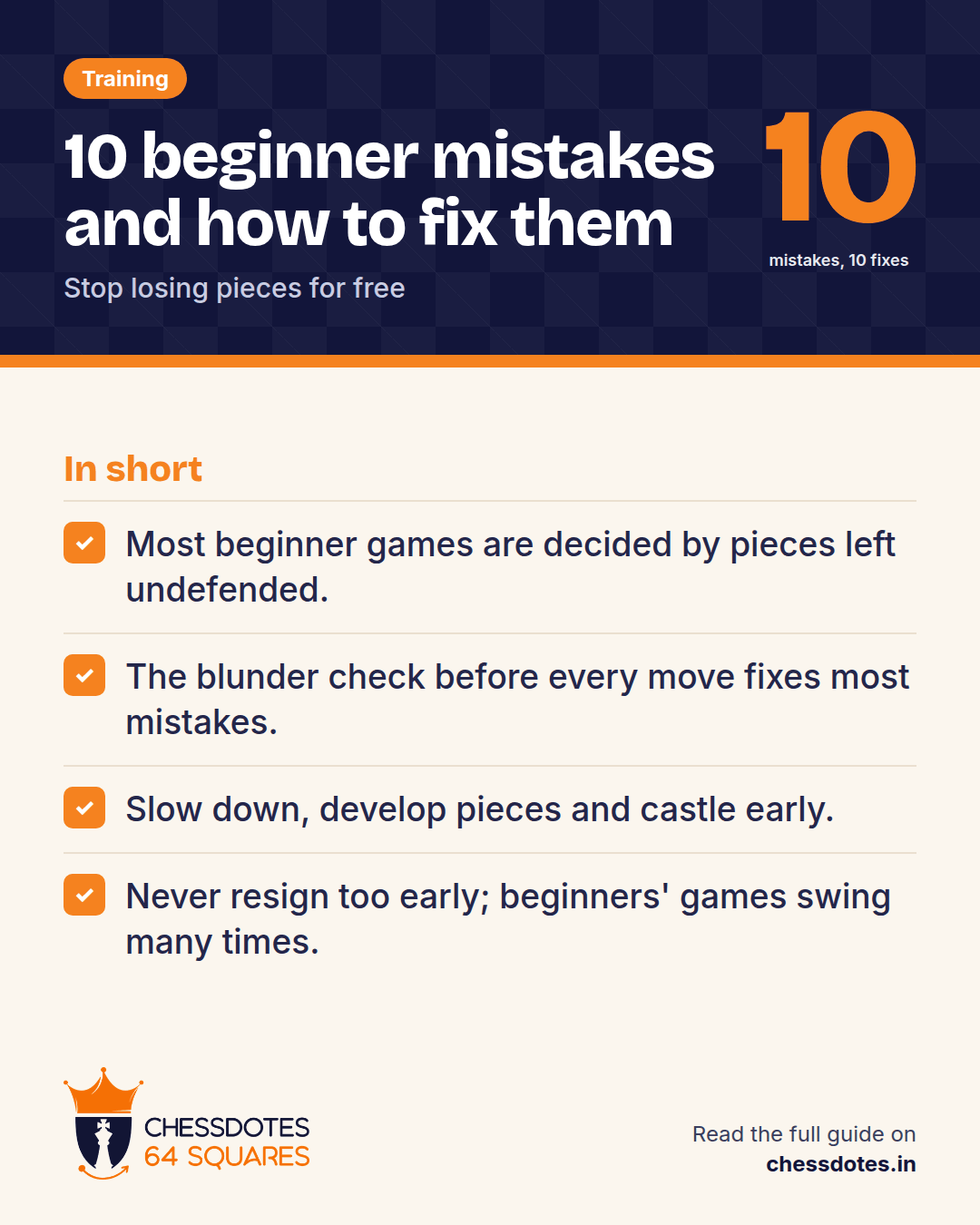
- Most beginner games are decided by pieces left undefended.
- The blunder check before every move fixes most mistakes.
- Slow down, develop pieces and castle early.
- Never resign too early; beginners’ games swing many times.
In this article
- 1. Leaving pieces undefended
- 2. Ignoring the opponent’s threat
- 3. Moving too fast
- 4. Bringing the queen out early
- 5. Not castling
- 6. Moving the same piece many times
- 7. Grabbing every pawn
- 8. Giving pointless checks
- 9. Giving up too early
- 10. Poor use of the clock
- The one habit that fixes most of them
- Frequently asked questions
10 mistakes and their fixes
| Mistake | The fix |
|---|---|
| Leaving pieces undefended | After every move, check which of your pieces are unprotected |
| Ignoring the opponent’s threat | Ask “why did they play that?” before you move |
| Moving too fast | Check checks, captures and threats before moving |
| Bringing the queen out early | Develop knights and bishops first |
| Not castling | Aim to castle in the first 10 moves |
| Moving the same piece many times | Bring a new piece into the game instead |
| Grabbing every pawn | Check whether the pawn is a trap |
| Giving pointless checks | Only check if it helps your plan |
| Giving up in a worse position | Keep fighting; look for tricks |
| Poor use of the clock | Spend time on key moments, not obvious recaptures |
1. Leaving pieces undefended
This is the number one reason beginners lose. A bishop or knight is left without protection and the opponent simply takes it. After each of your moves, quickly scan your pieces: is every piece protected, or on a square the opponent can’t attack?
2. Ignoring the opponent’s threat
Beginners often play their own plan and forget the opponent has one too. Before every move, ask: “Why did my opponent play that? What does it attack? What does it prepare?”
3. Moving too fast
In a 30-minute game, many beginners finish with 25 minutes left and a lost position. Time is a resource: use it on important moves.
4. Bringing the queen out early
An early queen gets chased by developing pieces, losing time. See our opening principles for a better start.
5. Not castling
A king in the centre is exposed once the position opens. Castle early, usually within the first 10 moves.
6. Moving the same piece many times
While one piece wanders around, the others stay at home. Each opening move should bring a new piece into play.
7. Grabbing every pawn
A free pawn is sometimes bait. Before capturing, check whether the capture walks into a fork, pin or mating attack.
8. Giving pointless checks
Checks feel strong, but a check that drives the king to a better square just wastes time. Give a check only if it wins material, leads to mate or improves your position.
9. Giving up too early
Beginners’ games swing many times. A player who is a piece down but keeps fighting often gets chances when the opponent relaxes. Never resign against a beginner.
10. Poor use of the clock
Some players rush; others think for ten minutes about an obvious recapture and then run out of time. Save time for the critical moments: when the position changes, when there’s a capture, or when you’re making a plan.
The one habit that fixes most of them
Blunder check, before every move
We call this the blunder check. Children who use it consistently for a month usually stop losing pieces for free. It takes 10 to 20 seconds per move, and it saves games.
Frequently asked questions
Q. How can I stop blundering pieces?
Use the blunder check before every move, and solve daily tactics puzzles to spot threats faster.
Q. Why do I play well in practice but badly in tournaments?
Nerves make players rush. Practise at tournament speed and use the blunder check deliberately.
Q. Should I resign when I’m losing?
At beginner level, almost never. Keep playing; your opponent may make mistakes too.
Q. How long does it take to stop making beginner mistakes?
With regular practice, most students cut these mistakes significantly within 2 to 3 months.
Q. Can a coach help with these?
Yes. Reviewing your games with a coach shows which mistakes you personally make most often.
Keep reading
Turn mistakes into lessons with our coaches.
Book a trial class at ChessDotes 64 Squares. Call or WhatsApp +91-9405520323.