
Beginners often try to memorise long opening lines, then feel lost when the opponent plays something different. At the start, it is far more useful to understand five simple principles. Follow them and you will get a good position against almost anything.
In short
- Control the centre with pawns and pieces.
- Develop knights and bishops quickly; don’t move one piece many times.
- Castle early to keep your king safe.
- Keep the queen back, and aim to connect your rooks.
In this article
The 5 principles, in order
Control the centre
Put pawns on e4 and d4 (or e5 and d5) early.
Develop your pieces
Bring out knights and bishops before moving the same piece twice.
Castle early
Get your king safe, usually within the first 10 moves.
Don’t bring the queen out too early
She becomes a target and you lose time.
Connect your rooks
When the back rank between your rooks is empty, development is complete.
1. Control the centre
The four central squares (e4, d4, e5 and d5) are the most important squares on the board. Pieces in the centre control more squares and can move quickly to either side. Pawns on e4 and d4 claim space and give your pieces room to develop.
2. Develop your pieces
“Development” means bringing pieces off the back rank into play. In the opening, every move should ideally bring a new piece into the game. Knights usually come out before bishops, because their best squares (f3, c3, f6, c6) are clear early.
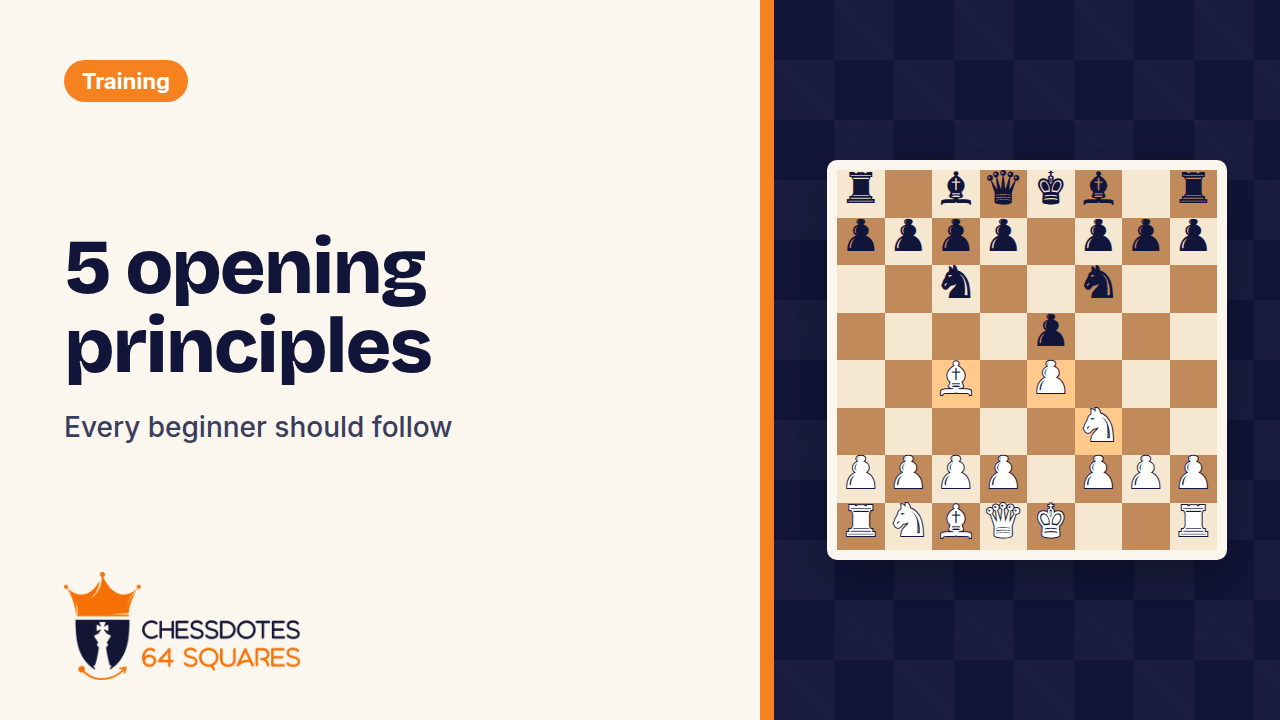
After 1.e4 e5 2.Nf3 Nc6 3.Bc4 Nf6: White has a centre pawn and two pieces developed, and is ready to castle.
3. Castle early
The king is safest tucked away in the corner, behind a wall of pawns. Castling also brings a rook towards the centre. Most games at club level are lost because a king stays in the middle too long and gets attacked.
4. Keep the queen back
The queen is your most powerful piece, which is exactly why bringing her out early is risky. Your opponent can attack her with knights and bishops, developing their pieces with tempo while you waste moves running away.
5. Connect your rooks
When your knights, bishops and queen have moved and you have castled, your two rooks can see each other along the back rank. That’s the sign your opening is complete, and it’s time to make a plan for the middlegame.
Common opening mistakes
Avoid these
| Mistake | Why it’s a problem | Better idea |
|---|---|---|
| Moving edge pawns (a, h) | Doesn’t help control the centre or develop | Play e4/d4 or develop a knight |
| Moving the same piece repeatedly | Other pieces stay undeveloped | Bring a new piece out |
| Early queen attacks | Queen gets chased, you lose time | Develop minor pieces first |
| Not castling | King gets attacked in the centre | Castle within about 10 moves |
| Grabbing pawns in the opening | Falls behind in development | Develop first, grab later if safe |
When should you learn named openings?
Named openings, like the Italian Game or the Sicilian Defence, are simply tested ways of following these principles. Once a child reliably plays good opening moves by principle, a coach can introduce one or two openings that suit their style. Understanding comes first; memorisation later.
Coach’s tip: After move 10, check: have I castled? Are both knights and bishops out? Is my queen safe? If yes, your opening went well.
Frequently asked questions
Q. What is the best opening for beginners?
Any opening that follows the principles. 1.e4 with quick development and castling is a great start.
Q. Should my child memorise openings?
Not at first. Principles come first. Specific openings are introduced once basics are solid.
Q. Is it bad to play the same opening every game?
Not at all. Playing one opening repeatedly helps you understand it deeply.
Q. Why do knights come before bishops?
Knights’ best squares are usually clear early, while the best bishop squares depend on pawn moves.
Q. Is e4 better than d4?
Both are excellent. At beginner level, the choice matters much less than following the principles.
Keep reading
Learn openings the right way, with a coach.
Book a trial class at ChessDotes 64 Squares. Call or WhatsApp +91-9405520323.