Parents often ask us, “Is chess just a game, or will it actually help my child?” After years of teaching children in Ratnagiri, our honest answer is that the skills chess builds show up everywhere: in the classroom, in exams, and in how children handle success and failure.
In short
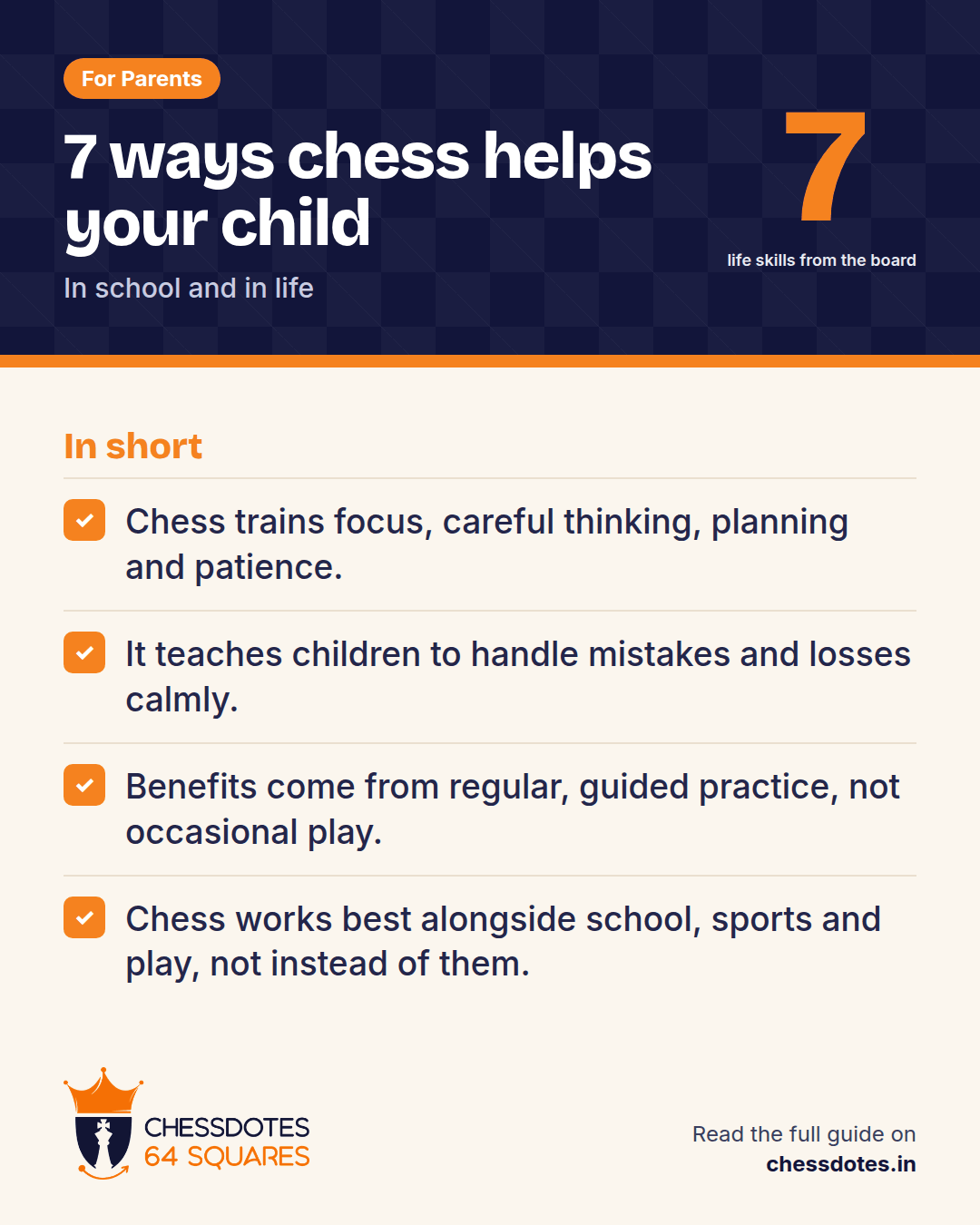
- Chess trains focus, careful thinking, planning and patience.
- It teaches children to handle mistakes and losses calmly.
- Benefits come from regular, guided practice, not occasional play.
- Chess works best alongside school, sports and play, not instead of them.
In this article
Why chess is more than a game
A chess game is a long series of decisions. Every move, a child has to look at the position, understand what is happening, consider choices, predict the opponent’s reply, and then commit. Nobody else can move for them. There is no luck and no hiding.
That is why chess is such a good training ground. The same process of look, think, choose, check is exactly what children need for maths problems, exam questions and everyday decisions.
7 benefits of chess for children
Longer focus
Games last 30 minutes to several hours. Children gradually learn to stay with one problem.
Think before acting
Every move has consequences. “Stop and check” becomes a habit.
Handling mistakes
Everyone blunders. Chess teaches you to find the best move in the new position.
Problem-solving
Puzzles are logic problems with a clear answer, solved step by step.
Planning and patience
Good chess means making a plan and carrying it out over many moves.
Sportsmanship
Every game ends with a handshake, win or lose.
Confidence and friends
Progress is visible, and the academy becomes a community.
1. Longer focus and concentration
Many children today are used to short videos and fast games. Chess asks for the opposite: sitting with one position for several minutes and thinking deeply. At first, beginners lose concentration quickly. Over weeks and months, their attention span grows, because the game rewards it. A child who looks carefully finds the winning move; a child who rushes loses a piece.
Parents often tell us that homework time becomes calmer after a few months of chess. That is not magic. It is simply practice at concentrating.
2. Thinking before acting
In chess, you cannot take a move back. That single rule teaches children to pause and check before committing. We teach every student a simple checklist before each move.
The blunder check, before every move
Children who follow these three questions stop losing pieces for free within a few weeks. The bigger win is the habit: stop, think, then act.
3. Handling mistakes and losses
Every chess player loses games and makes blunders, including world champions. What matters is what you do next. In chess, a mistake doesn’t end the game. You look at the new position and find the best move from there.
This builds resilience. A child who learns to keep fighting after losing a piece is learning to keep trying after a bad test or a missed goal. After the game, reviewing a loss teaches that mistakes are information, not failures.
From our classroom
A young player had a tough start to the tournament and lost a few of his early games. The losses were difficult – there were even a few tears along the way.
But he didn’t give up. He came back for the next games, kept fighting, and started winning. By the end of the day, his determination had earned him the Best Under-7 Player Trophy.
And the tears from earlier in the day were replaced by the biggest smile. That’s the magic of chess. It teaches children that one loss is never the end of the game – you can always make your next move.
There are countless stories like this in every tournament. Some win trophies, some win confidence, and some simply learn to keep going.
Every game is a lesson. Every move is a new beginning!!
4. Problem-solving and logical thinking
Chess puzzles are small logic problems: find the move that wins material or gives checkmate. To solve them, children break the problem into steps, test ideas, and check their answer. These are the same skills used in maths and science.
5. Planning and patience
Beginners play one move at a time. Stronger players make plans: improve the worst piece, attack a weak pawn, bring the rook to an open file. Carrying out a plan over ten or twenty moves teaches children to set a goal and work towards it patiently.
6. Sportsmanship and respect
Chess has a strong culture of respect. Players shake hands before and after every game. They stay quiet so others can think. They accept the arbiter’s decisions. Children learn to congratulate an opponent after a loss and to stay humble after a win.
7. Confidence and a community
Chess progress is visible: first you learn the rules, then you win your first game, then your first tournament point, then maybe a trophy or a rating. Each step builds confidence. Chess also gives children a community: friends at the academy, rivals at tournaments, and adults who share their passion.
What chess won’t do
It is worth being honest. Chess is not a shortcut to top marks, and it does not replace good teaching at school. The benefits come from regular, structured practice with good guidance over months and years, not from occasional games. And chess should sit alongside outdoor play, sports and friends, not replace them.
For parents: A little practice most days beats a long session once a month. Our 20-minute home routine shows exactly how.
Frequently asked questions
Q. Does chess really improve marks at school?
Chess builds concentration, careful thinking and patience, which help with studies. It is not a guarantee of higher marks, but many parents notice calmer, more focused study habits.
Q. My child gets upset after losing. Should they still play?
Yes. Learning to handle losses is one of chess’s biggest benefits. Coaches help children see losses as lessons, and it gets easier with time.
Q. How much time does my child need to spend on chess?
For most children, one or two classes a week plus about 20 minutes of daily practice is enough.
Q. Is chess good for shy children?
Very often, yes. Chess lets children express themselves through their moves, and progress builds confidence.
Q. Is online chess as good as playing on a board?
Online chess helps, but long games on a real board build focus best, especially for young children.
Keep reading
Want to see how your child responds to chess?
Book a trial class at ChessDotes 64 Squares. Call or WhatsApp +91-9405520323.